
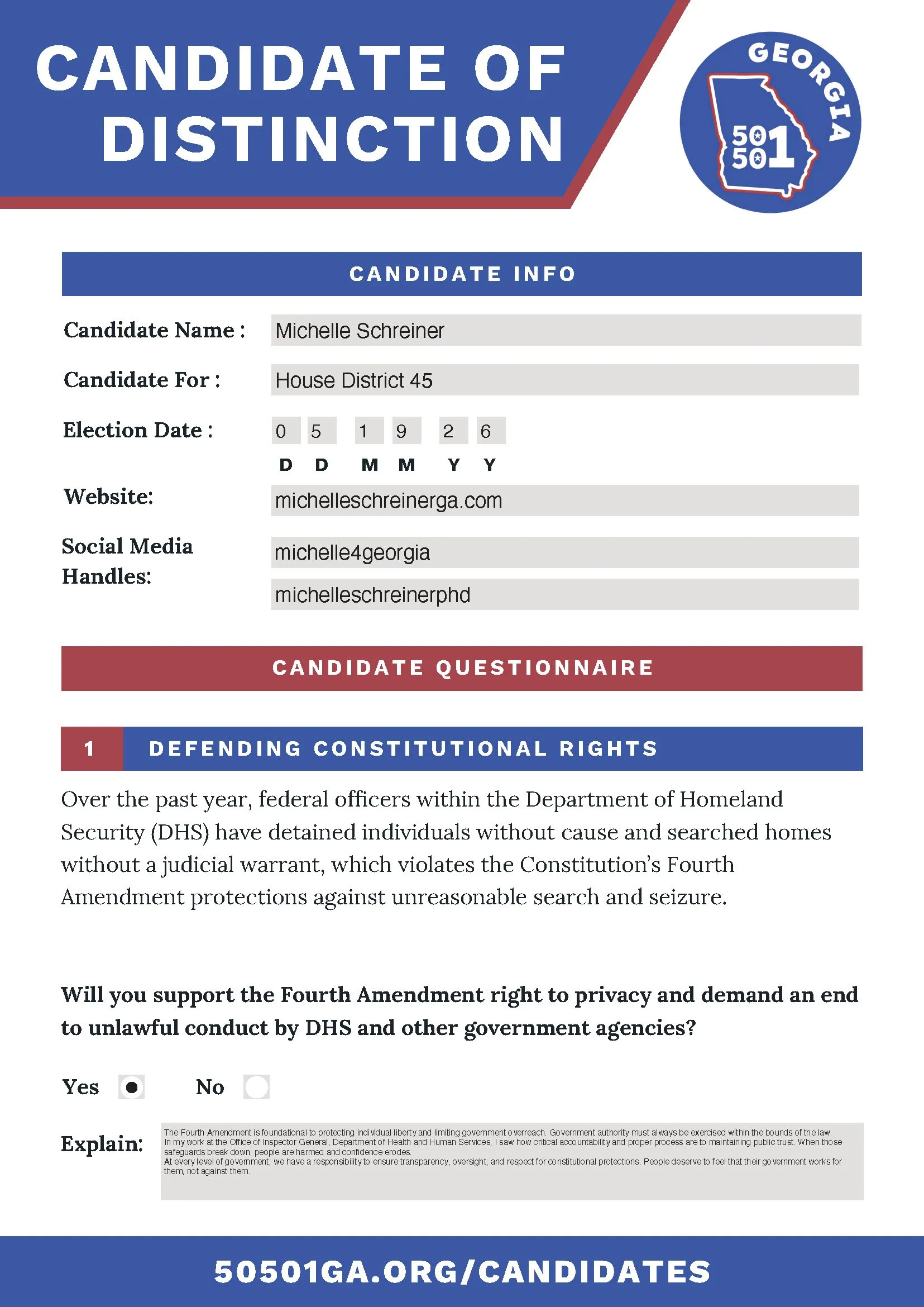
Michelle Schreiner: Candidate For GA State House District 45
Michelle Schreiner, Candidate For GA State House District 45
Election Date: May 19, 2026
Candidate Website: michelleschreinerga.com
Candidate Instagram: https://www.instagram.com/michelle4georgia/
Candidate Facebook: https://www.facebook.com/Michelle-for-Georgia-102498848971162
See your sample ballot and all candidates for this and every election here: https://mvp.sos.ga.gov/s/
Question 1 Topic: Defending Constitutional Rights
Question: Over the past year, federal officers within the Department of Homeland Security (DHS) have detained individuals without cause and searched homes without a judicial warrant, which violates the Constitution’s Fourth Amendment protections against unreasonable search and seizure.
Will you support the Fourth Amendment right to privacy and demand an end to unlawful conduct by DHS and other government agencies?
Answer: Yes
Explanation: The Fourth Amendment is foundational to protecting individual liberty and limiting government overreach. Government authority must always be exercised within the bounds of the law.
In my work at the Office of Inspector General, Department of Health and Human Services, I saw how critical accountability and proper process are to maintaining public trust. When those safeguards break down, people are harmed and confidence erodes.
At every level of government, we have a responsibility to ensure transparency, oversight, and respect for constitutional protections. People deserve to feel that their government works for them, not against them.
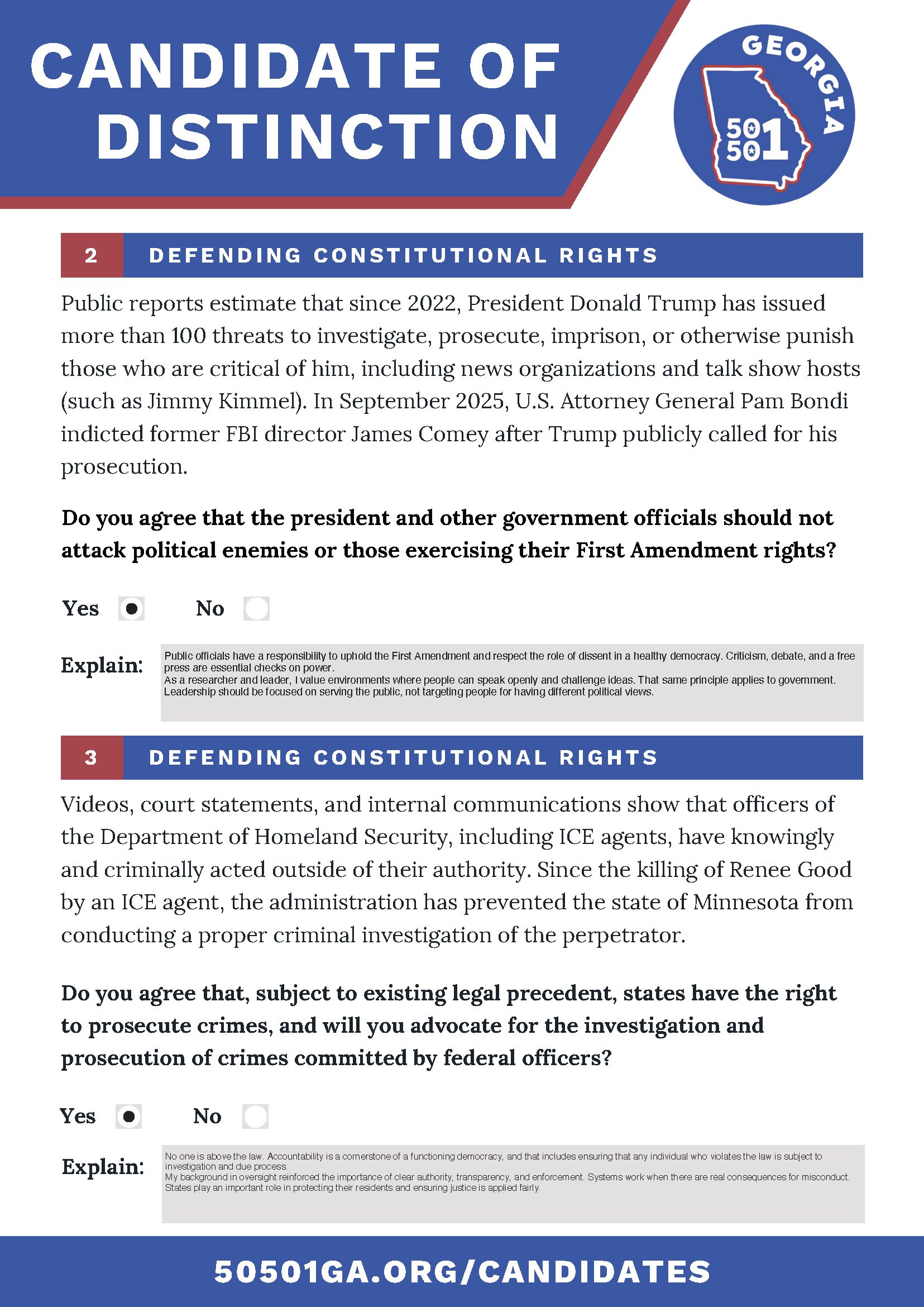
Question 2 Topic: Defending Constitutional Rights
Question: Public reports estimate that since 2022, President Donald Trump has issued more than 100 threats to investigate, prosecute, imprison, or otherwise punish those who are critical of him, including news organizations and talk show hosts (such as Jimmy Kimmel). In September 2025, U.S. Attorney General Pam Bondi indicted former FBI director James Comey after Trump publicly called for his prosecution.
Do you agree that the president and other government officials should not attack political enemies or those exercising their First Amendment rights?
Answer: Yes
Explanation: Public officials have a responsibility to uphold the First Amendment and respect the role of dissent in a healthy democracy. Criticism, debate, and a free press are essential checks on power.
As a researcher and leader, I value environments where people can speak openly and challenge ideas. That same principle applies to government.
Leadership should be focused on serving the public, not targeting people for having different political views.
Question 3 Topic: Defending Constitutional Rights
Question: Videos, court statements, and internal communications show that officers of the Department of Homeland Security, including ICE agents, have knowingly and criminally acted outside of their authority. Since the killing of Renee Good by an ICE agent, the administration has prevented the state of Minnesota from conducting a proper criminal investigation of the perpetrator.
Do you agree that, subject to existing legal precedent, states have the right to prosecute crimes, and will you advocate for the investigation and prosecution of crimes committed by federal officers?
Answer: Yes
Explanation: No one is above the law. Accountability is a cornerstone of a functioning democracy, and that includes ensuring that any individual who violates the law is subject to investigation and due process.
My background in oversight reinforced the importance of clear authority, transparency, and enforcement. Systems work when there are real consequences for misconduct.
States play an important role in protecting their residents and ensuring justice is applied fairly.
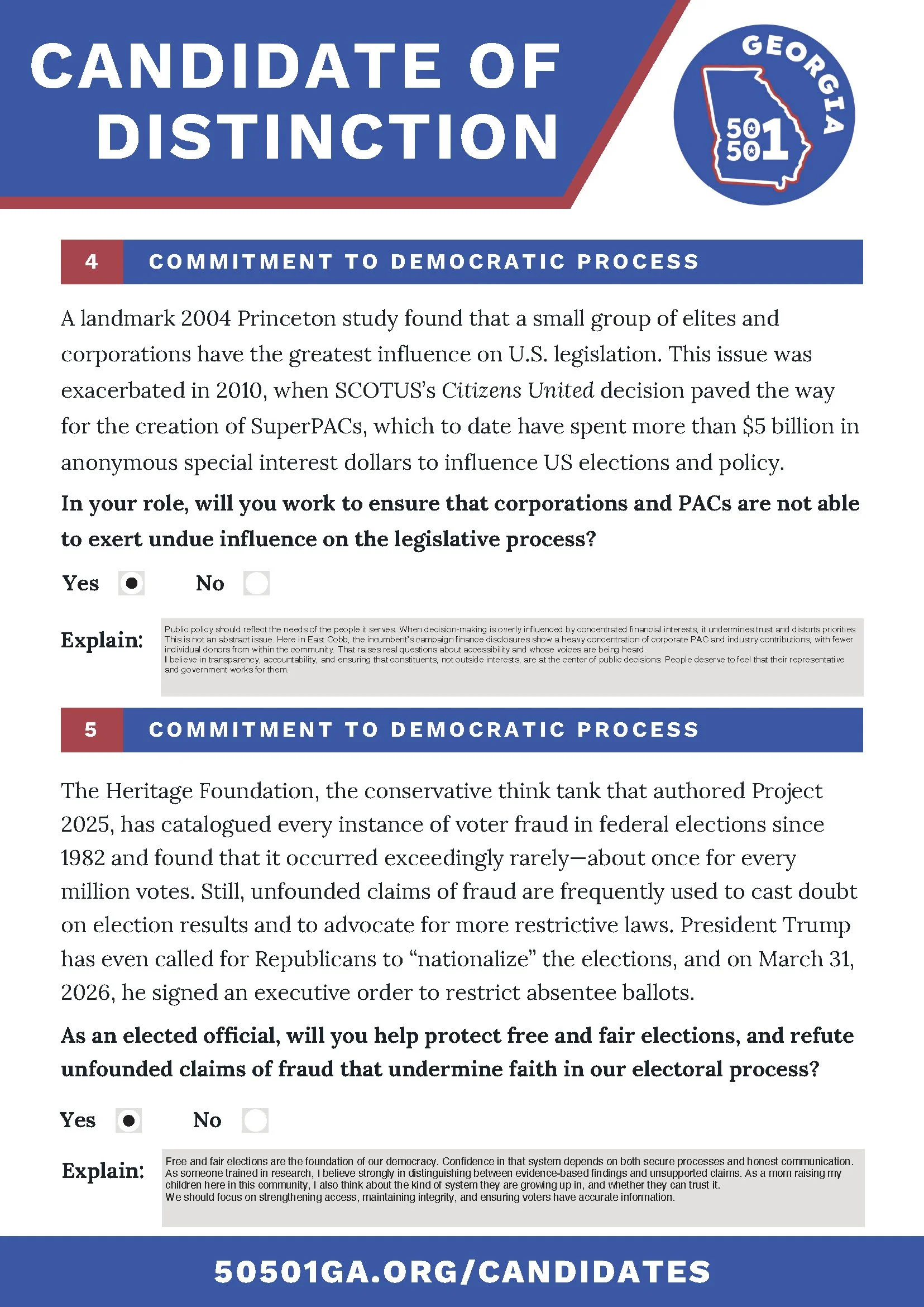
Question 4 Topic: Commitment To Democratic Process
A landmark 2004 Princeton study found that a small group of elites and
corporations have the greatest influence on U.S. legislation. This issue was
exacerbated in 2010, when SCOTUS’s Citizens United decision paved the way
for the creation of SuperPACs, which to date have spent more than $5 billion in
anonymous special interest dollars to influence US elections and policy.
In your role, will you work to ensure that corporations and PACs are not able
to exert undue influence on the legislative process?
Answer: Yes
Explanation: Public policy should reflect the needs of the people it serves. When decision-making is overly influenced by concentrated financial interests, it undermines trust and distorts priorities.
This is not an abstract issue. Here in East Cobb, the incumbent’s campaign finance disclosures show a heavy concentration of corporate PAC and industry contributions, with fewer individual donors from within the community. That raises real questions about accessibility and whose voices are being heard.
I believe in transparency, accountability, and ensuring that constituents, not outside interests, are at the center of public decisions. People deserve to feel that their representative and government works for them.
Question 5 Topic: Commitment To Democratic Process
The Heritage Foundation, the conservative think tank that authored Project
2025, has catalogued every instance of voter fraud in federal elections since
1982 and found that it occurred exceedingly rarely—about once for every
million votes. Still, unfounded claims of fraud are frequently used to cast doubt
on election results and to advocate for more restrictive laws. President Trump
has even called for Republicans to “nationalize” the elections, and on March 31,
2026, he signed an executive order to restrict absentee ballots.
As an elected official, will you help protect free and fair elections, and refute
unfounded claims of fraud that undermine faith in our electoral process?
Answer: Yes
Explanation: Free and fair elections are the foundation of our democracy. Confidence in that system depends on both secure processes and honest communication.
As someone trained in research, I believe strongly in distinguishing between evidence-based findings and unsupported claims. As a mom raising my children here in this community, I also think about the kind of system they are growing up in, and whether they can trust it.
We should focus on strengthening access, maintaining integrity, and ensuring voters have accurate information.
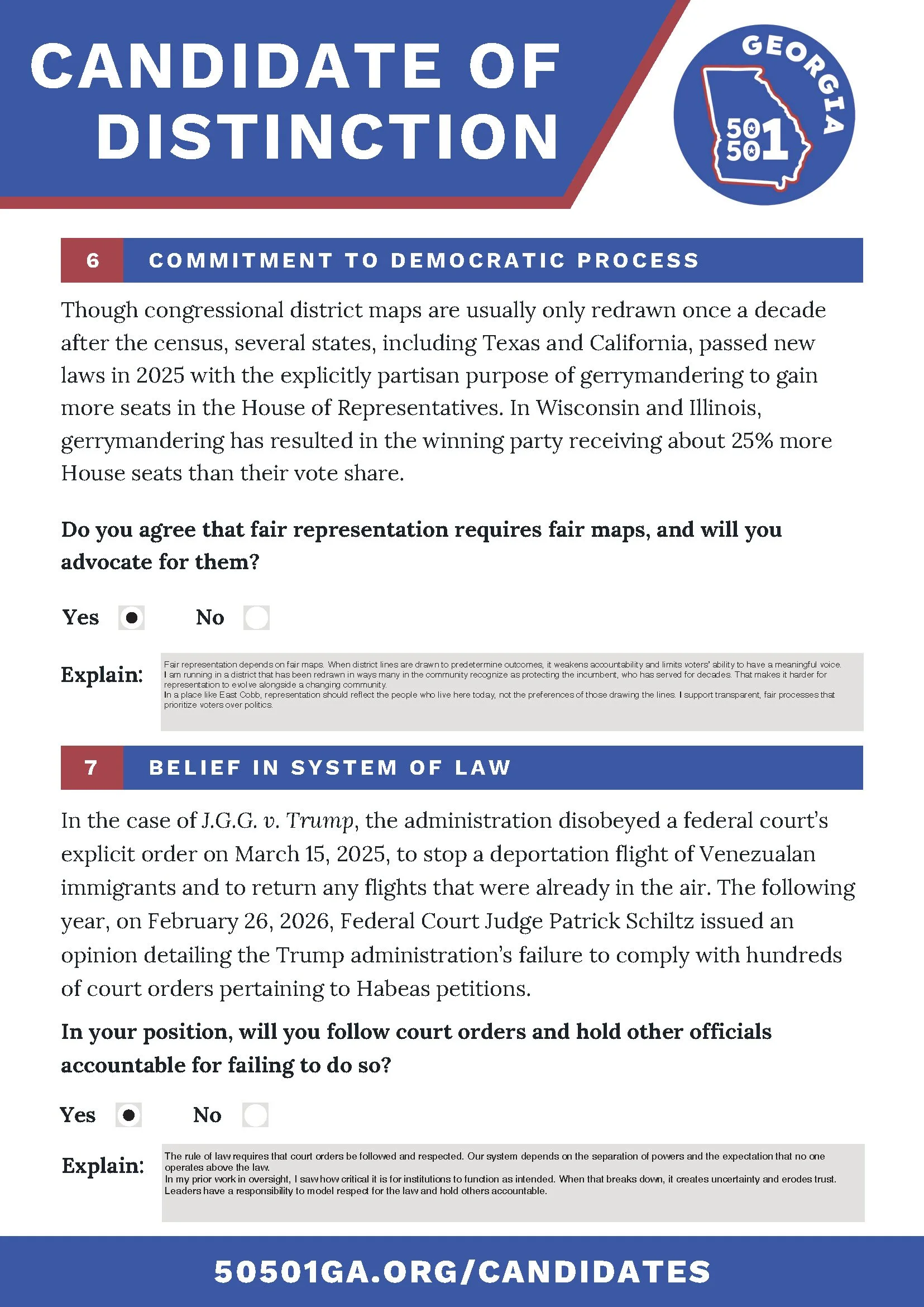
Question 6 Topic: Commitment To Democratic Process
Though congressional district maps are usually only redrawn once a decade after the census, several states, including Texas and California, passed new laws in 2025 with the explicitly partisan purpose of gerrymandering to gain more seats in the House of Representatives. In Wisconsin and Illinois, gerrymandering has resulted in the winning party receiving about 25% more House seats than their vote share.
Do you agree that fair representation requires fair maps, and will you advocate for them?
Answer: Yes
Explanation: Fair representation depends on fair maps. When district lines are drawn to predetermine outcomes, it weakens accountability and limits voters’ ability to have a meaningful voice.
I am running in a district that has been redrawn in ways many in the community recognize as protecting the incumbent, who has served for decades. That makes it harder for representation to evolve alongside a changing community.
In a place like East Cobb, representation should reflect the people who live here today, not the preferences of those drawing the lines. I support transparent, fair processes that prioritize voters over politics.
Question 7 Topic: Belief In System of Law
In the case of J.G.G. v. Trump, the administration disobeyed a federal court’s
explicit order on March 15, 2025, to stop a deportation flight of Venezualan
immigrants and to return any flights that were already in the air. The following
year, on February 26, 2026, Federal Court Judge Patrick Schiltz issued an
opinion detailing the Trump administration’s failure to comply with hundreds
of court orders pertaining to Habeas petitions.
In your position, will you follow court orders and hold other officials
accountable for failing to do so?
Answer: Yes
Explanation: The rule of law requires that court orders be followed and respected. Our system depends on the separation of powers and the expectation that no one operates above the law.
In my prior work in oversight, I saw how critical it is for institutions to function as intended. When that breaks down, it creates uncertainty and erodes trust.
Leaders have a responsibility to model respect for the law and hold others accountable.
Question 8 Topic: Belief In System of Law
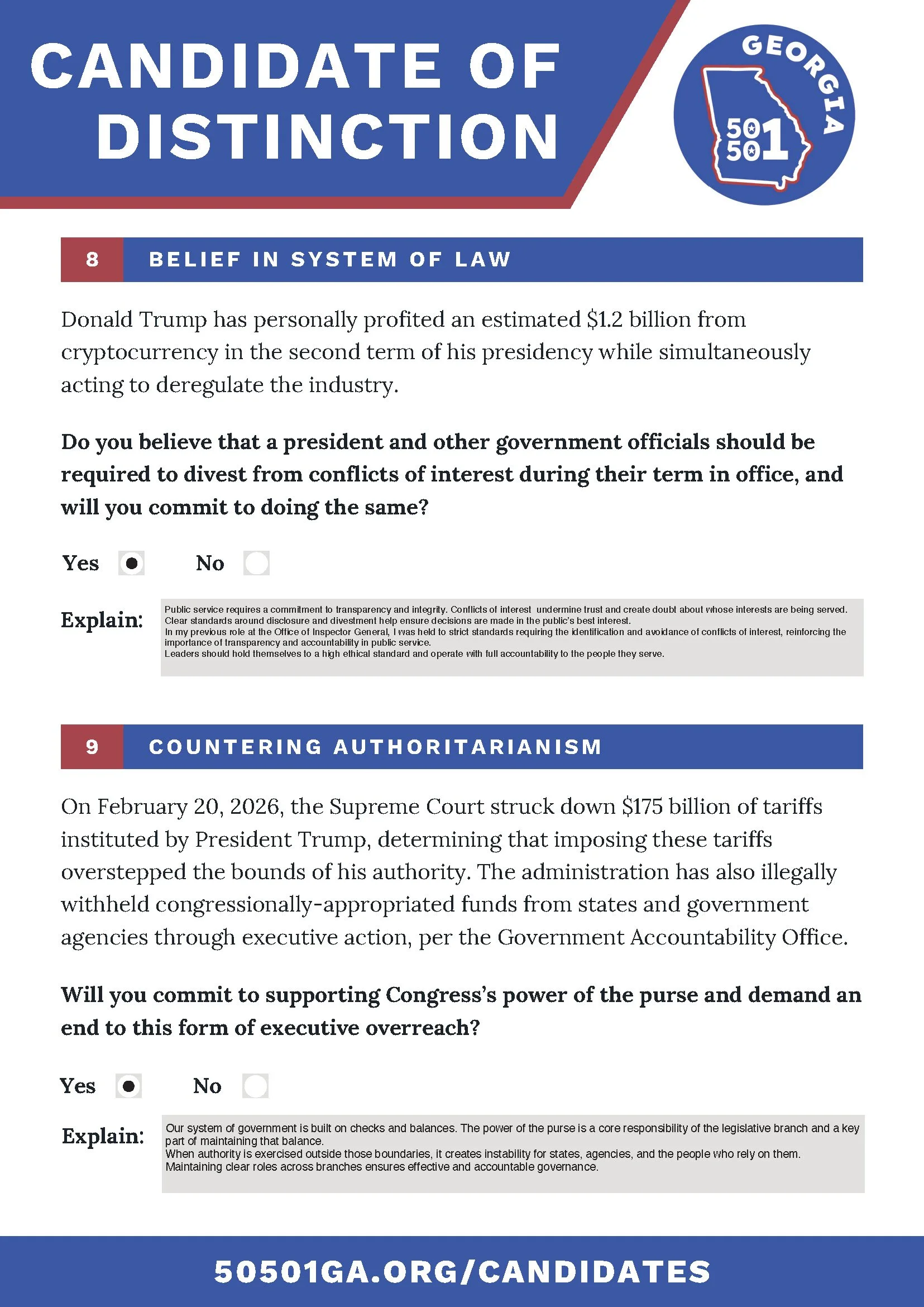
Donald Trump has personally profited an estimated $1.2 billion from cryptocurrency in the second term of his presidency while simultaneously acting to deregulate the industry.
Do you believe that a president and other government officials should be required to divest from conflicts of interest during their term in office, and will you commit to doing the same?
Answer: Yes
Explanation: Public service requires a commitment to transparency and integrity. Conflicts of interest undermine trust and create doubt about whose interests are being served.
Clear standards around disclosure and divestment help ensure decisions are made in the public’s best interest.
In my previous role at the Office of Inspector General, I was held to strict standards requiring the identification and avoidance of conflicts of interest, reinforcing the importance of transparency and accountability in public service.
Leaders should hold themselves to a high ethical standard and operate with full accountability to the people they serve.
Question 9 Topic: Countering Authoritarianism
On February 20, 2026, the Supreme Court struck down $175 billion of tariffs instituted by President Trump, determining that imposing these tariffs overstepped the bounds of his authority. The administration has also illegally withheld congressionally-appropriated funds from states and government agencies through executive action, per the Government Accountability Office.
Will you commit to supporting Congress’s power of the purse and demand an end to this form of executive overreach?
Answer: Yes
Explanation: Our system of government is built on checks and balances. The power of the purse is a core responsibility of the legislative branch and a key part of maintaining that balance.
When authority is exercised outside those boundaries, it creates instability for states, agencies, and the people who rely on them.
Maintaining clear roles across branches ensures effective and accountable governance.
Question 10 Topic: Countering Authoritarianism
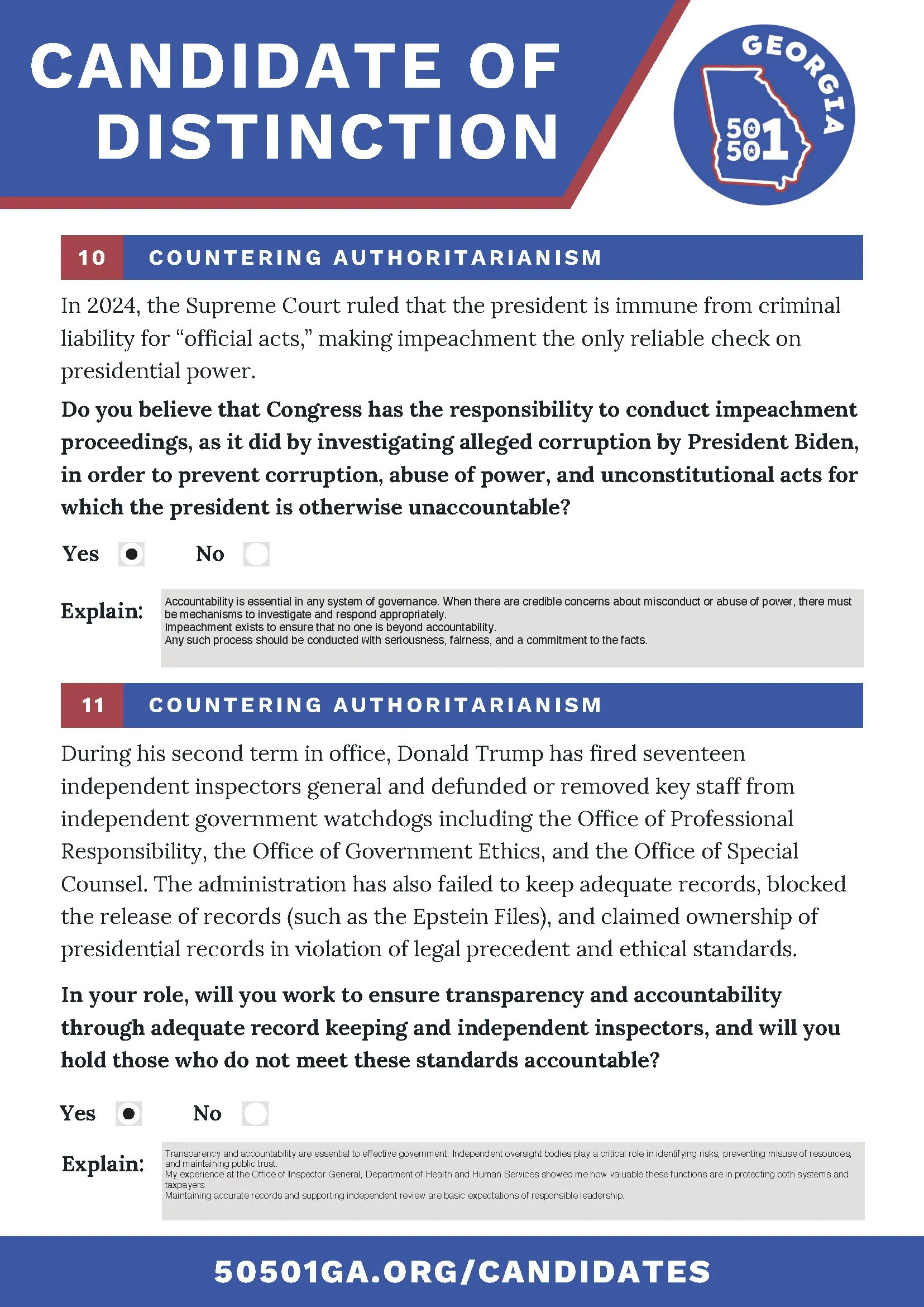
In 2024, the Supreme Court ruled that the president is immune from criminal liability for “official acts,” making impeachment the only reliable check on presidential power.
Do you believe that Congress has the responsibility to conduct impeachment proceedings, as it did by investigating alleged corruption by President Biden, in order to prevent corruption, abuse of power, and unconstitutional acts for which the president is otherwise unaccountable?
Answer: Yes
Explanation: Accountability is essential in any system of governance. When there are credible concerns about misconduct or abuse of power, there must be mechanisms to investigate and respond appropriately.
Impeachment exists to ensure that no one is beyond accountability.
Any such process should be conducted with seriousness, fairness, and a commitment to the facts.
Question 11 Topic: Countering Authoritarianism
During his second term in office, Donald Trump has fired seventeen independent inspectors general and defunded or removed key staff from independent government watchdogs including the Office of Professional Responsibility, the Office of Government Ethics, and the Office of Special Counsel. The administration has also failed to keep adequate records, blocked the release of records (such as the Epstein Files), and claimed ownership of presidential records in violation of legal precedent and ethical standards.
In your role, will you work to ensure transparency and accountability through adequate record keeping and independent inspectors, and will you hold those who do not meet these standards accountable?
Answer: Yes
Explanation: Transparency and accountability are essential to effective government. Independent oversight bodies play a critical role in identifying risks, preventing misuse of resources, and maintaining public trust.
My experience at the Office of Inspector General, Department of Health and Human Services showed me how valuable these functions are in protecting both systems and taxpayers.
Maintaining accurate records and supporting independent review are basic expectations of responsible leadership.
Question 12 Topic: Truth in Public Discourse and Decision-Making
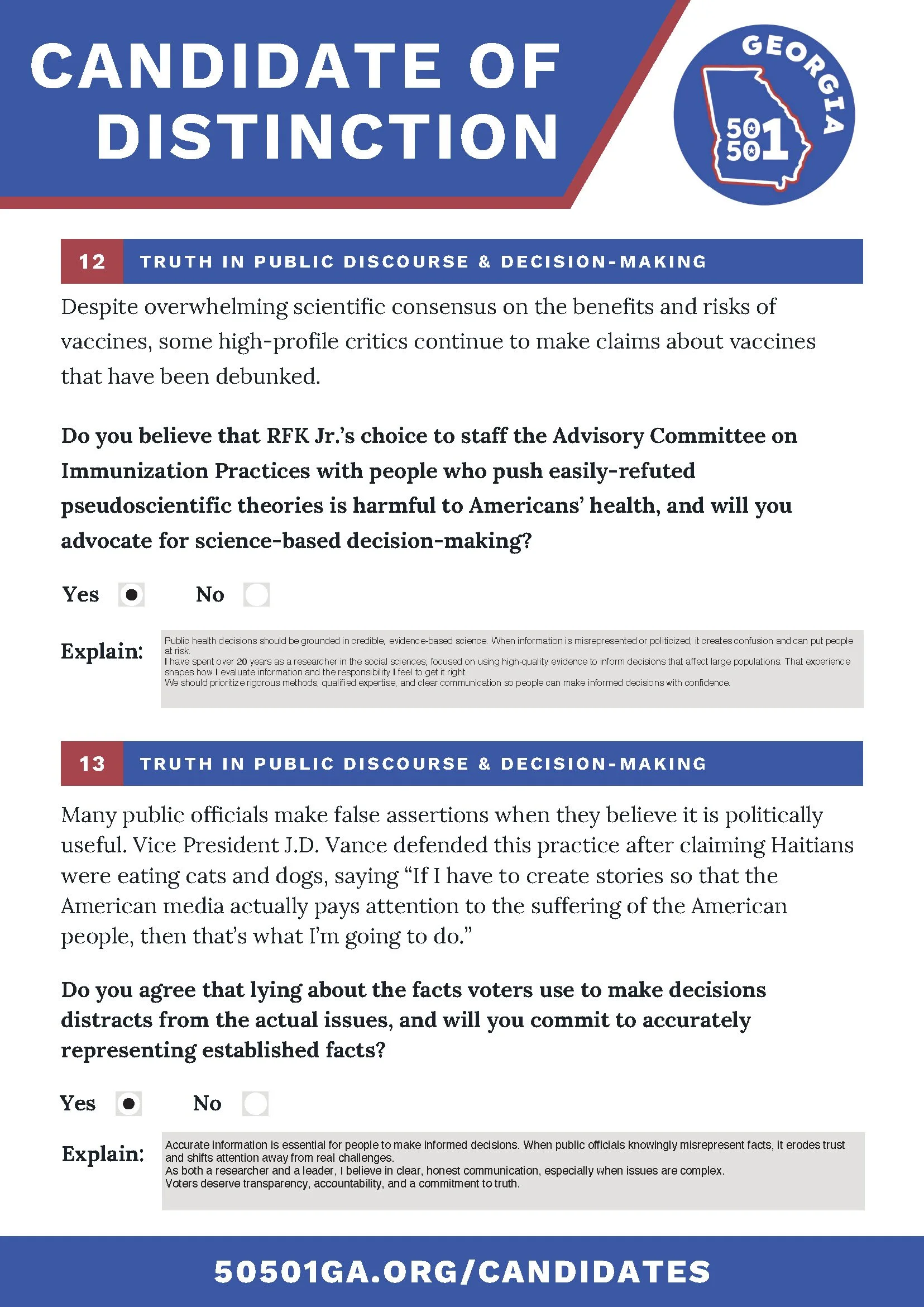
Despite overwhelming scientific consensus on the benefits and risks of vaccines, some high-profile critics continue to make claims about vaccines that have been debunked. Do you believe that RFK Jr.’s choice to staff the Advisory Committee on Immunization Practices with people who push easily-refuted pseudoscientific theories is harmful to Americans’ health, and will you advocate for science-based decision-making?
Answer: Yes
Explanation: Public health decisions should be grounded in credible, evidence-based science. When information is misrepresented or politicized, it creates confusion and can put people at risk.
I have spent over 20 years as a researcher in the social sciences, focused on using high-quality evidence to inform decisions that affect large populations. That experience shapes how I evaluate information and the responsibility I feel to get it right.
We should prioritize rigorous methods, qualified expertise, and clear communication so people can make informed decisions with confidence.
Question 13 Topic: Truth in Public Discourse and Decision-Making
Many public officials make false assertions when they believe it is politically useful. Vice President J.D. Vance defended this practice after claiming Haitians were eating cats and dogs, saying “If I have to create stories so that the American media actually pays attention to the suffering of the American people, then that’s what I’m going to do.”
Do you agree that lying about the facts voters use to make decisions distracts from the actual issues, and will you commit to accurately representing established facts?
Answer: Yes
Explanation: Accurate information is essential for people to make informed decisions. When public officials knowingly misrepresent facts, it erodes trust and shifts attention away from real challenges.
As both a researcher and a leader, I believe in clear, honest communication, especially when issues are complex.
Voters deserve transparency, accountability, and a commitment to truth.